Showing posts with label arepas. Show all posts

Wednesday, September 9, 2015

Venezuelan Arepas Go International on 12 September


Come Join the Venezuelan Arepa Party at Cargo, Shoreditch, on 12 September 


On Saturday 12 September Venezuelans around the world will be flying their national flag, playing Venezuelan music, and gathering together in an act of gastronomic unity to enjoy the country's most emblematic national dish: arepas.

That's because the 12th of September has been christened World Arepa Day (El Dia Mundial de la Arepa), an international event that aims to spread the word about this scrumptious South American street food and turn on local foodies, adventurous eaters, and gastronauts to the joys of the arepa.

These cornflour patties, made from Harina PAN, can be eaten plain, or stuffed with delicious fillings like shredded beef, shredded chicken, black beans, grated cheese, fried plantains and dollops of goopy avocado sauce called guasacaca..

In London, the place to be for this culinary celebration is at the outdoor food area by Cargo, at 89 Rivington Street in Shoreditch, where the folks from the Guasacaca food stall will be cooking up a full spread of fillings to delight all tastes, including vegetarian options, from 12-8 pm (although under 18's can only stay until 4 pm).

One must-try arepa is the Reina Pepiada, a lip-smacking combination of shredded chicken, mashed avocado, mayonnaise and peas. Not surprisingly for Venezuela - famous for the stunning beauty of its lady folk - the Reina Pepiada is named after local lovely Susana Dujim, who won Miss World in 1955.

All the arepas cost £6 and you can mix and match any of the fillings on the menu.

According to David Gutierrez Aznar, who runs Guasacaca, it's a huge honour to create a little corner of Venezuela in London on such an important day.
Harina PAN goodie bags

"We really want to make Venezuelans in London feel like they are at home on 12 September, with traditional games, music and, of course, the traditional flavours of our arepas," says David.

"But we also want British people to come over and try our food because every year we do this the feedback is incredible and when people here try our arepas they really love them."

To set a party mood Chebeto Requena, a Venezuelan musician based in London will be providing traditional tunes throughout the afternoon, and Santa Teresa rum cocktails should warm things up if the weather turns cold.,

Guasacaca have also put together some Harina PAN goodie-bags with a kilo of flour, and a booklet of recipes showing how to make arepas. The bags will be raffled on the day.

For more information follow @guascacalondon on Twitter and the hashtags #WorldArepaDay, #DiaMundialDeLaArepa, and #ArepaLovers
The outdoor space at Cargo will be covered in the yellow, red, and blue of the Venezuelan flag on Saturday, 12 September, to celebrate World Arepa Day. 

Monday, October 27, 2014

Arepas arrive in London's hipster-haven Brick Lane

All text and photographs copyright Russell Maddicks
Follow me on Twitter: @venezuelaguide

It's only fitting that one of East London's trendiest hipster hangouts now has a food truck selling this year's hottest new street food: arepas.

In Venezuela and Colombia these fluffy corn-dough pockets are stuffed with tasty savoury fillings like beef, chicken and cheese to make snacks you can eat anytime of the day.

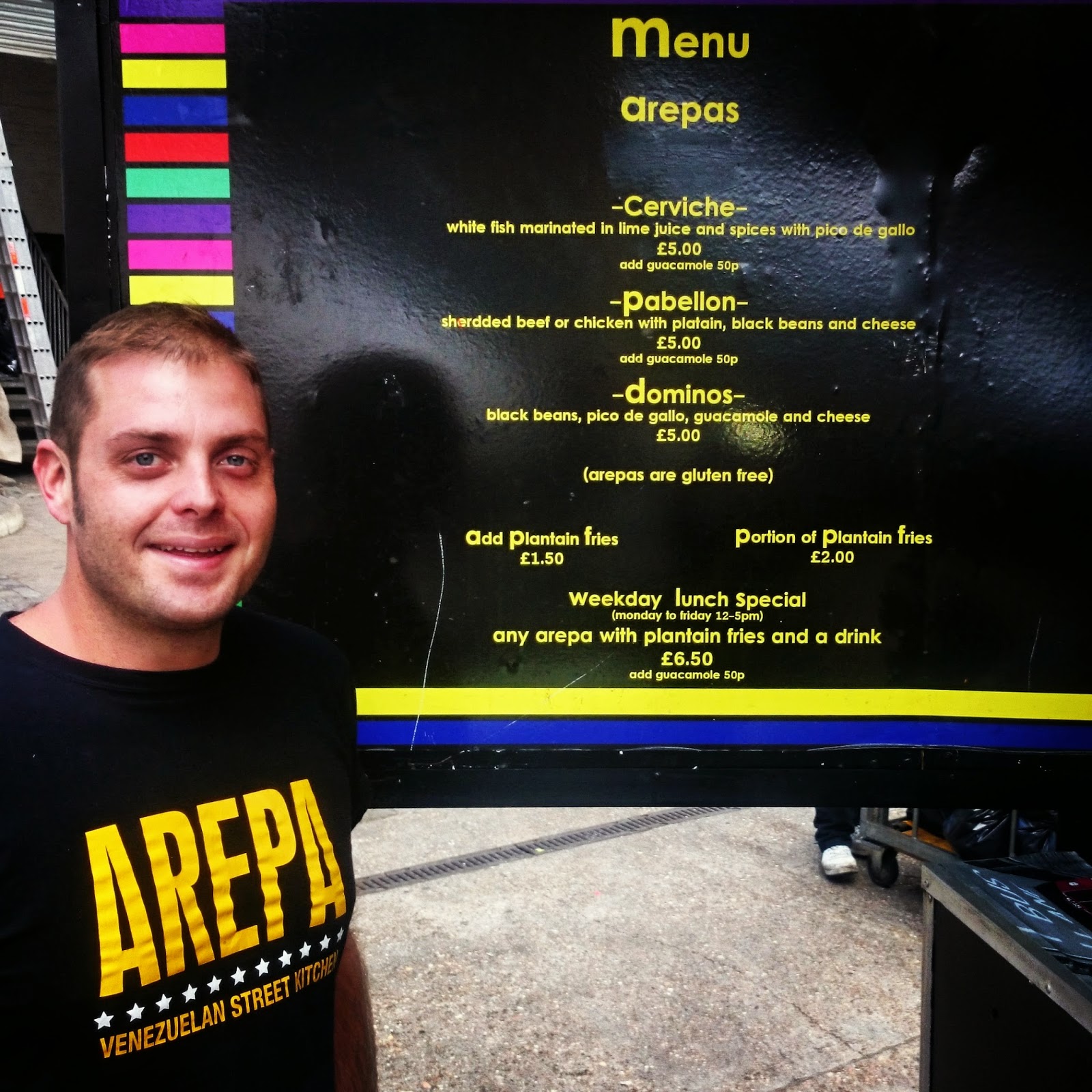
Now Venezuelan expat Giacomo Tomaselli and his Polish partner Inga have brought their own twist on classic arepa recipes to the Brick Lane area.

It's not hard to find them: a massive sign announces "Arepa: Venezuelan Street Kitchen" and some very tropical multicoloured stripes decorate their shiny black Arepazos Bros food truck in Ely's Yard. This otherwise unremarkable car park round the back of the Old Truman Brewery (E1 6QL) comes alive from midday as the food trucks open up and the area fills with diners taking a break from browsing the market stalls, pop-up art galleries, vintage clothes shops, and racks of vinyl in the Rough Trade indie record store.

The menu features a choice of three arepa fillings: the traditional pabellon (shredded beef or chicken with plantain, black beans and cheese), the vegetarian domino (black beans, grated cheese, pico de gallo, and guacamole), and the Peruvian inspired ceviche (fish marinated in lemon juice).

Giacomo explained that after much experimentation he had decided to add a fresh-tasting Mexican-style pico de gallo sauce to his arepas made from roughly-chopped tomato, onion, and coriander.

He also serves a thick avocado guacamole, rather than the runnier Venezuelan sauce known as guasacaca.

The day I went I had the pabellon. The shredded beef was just right, the guacamole was thick and creamy, and the plantain fries were crispy.

A set of benches in front of the stall offers covered seating for customers. Five other food trucks sell a variety of burgers, chicken and pulled pork if there's somebody in your party who wants an alternative to arepas.

You can even bring your own booze if you want to wash down your arepas with a few cold beers bought from a local corner store (always a great way to save a few pennies).


Giacomo is originally from Caraballeda, a town on the Caribbean coast of Venezuela near the capital Caracas. His grandfather ran a famous ice-cream parlour called Helados Tomaselli near the old Macuto Sheraton. The food truck is Giacomo's very own creation, made from an old horse box.
If you come from Liverpool Street Tube station the route takes you past the old Spitalfield's Market and entry to Ely's Yard is from Hanbury Street, or Dray Walk if you're coming from Brick Lane.
 
Once you've eaten your arepas you can check out the Brick Lane clothes market and some of the street art in the area. 

There's at least one Banksy painted on a wall in Brick Lane. The street is famous for its Bangladeshi curry houses, although if you come on a Sunday when the local markets are in full swing, be ready to to wade through the hordes of hipsters in skinny jeans and Doc Martin boots that fill the streets.

Tuesday, September 2, 2014

The Venezuelan Bollito - A Boiled Cornflour Snack

For a typical Venezuelan breakfast, when you are short of time, try boiling your cornflour dough instead of making arepas. The resulting submarine-shaped "bollos" are ready in just 15 minutes. (photo copyright Russell Maddicks)

That white submarine at the back of the plate is a bollo (pronounced: bo-jyo), also known as a bollito (pronounced: bo-jyito).
They are made from the same dough used to make arepas, from pre-cooked corn flour.
Like many Venezuelans I use Harina Pan to make my arepas and bollos.
All you need to do is add water and knead the dough until you can shape it easily and it isn't too dry to form cracks.
Instead of forming the dough into flying saucer shapes and frying or baking your arepas, bollos are roughly shaped into submarines and boiled in water for about 15 minutes. You know they are ready when they float to the surface.
It's a really quick way to get your daily cornbread fix.
For breakfast I like to serve bollitos with perico (eggs scrambled with onions and tomatoes) and grated yellow cheese.
In some places in Venezuela, you find bollo pelon, which are bollos stuffed with minced beef or shredded chicken cooked in a sauce.
In Colombia, the bollo limpio is slightly different as the corn dough submarines are wrapped in a corn husk before being boiled.
In Venezuela this kind of bollo is called an hallaquita.
Just to confuse matters further, in Ecuador and some other Andean countries, there is a very similar corn dish called humita. These are typically made from fresh ground corn which is wrapped in corn husks and steamed, often with cheese mixed into the dough.
The ultimate bollo is the hallaca, a cornmeal-dough pocket stuffed with a host of tasty ingredients, wrapped in a plantain leaf, which is eaten at Christmas.

Related recipes:
How to Make Arepas
How to Make Perico
How to Make Hallacas 

#Venezuelan #food #bollos #hallaquitas #arepas

Wednesday, September 11, 2013

Celebrate World Arepa Day, London, 14 September


Saturday, 14 September is Arepazo Mundial - World Arepa Day - and food stalls and restaurants all over the world will be celebrating the staple food of Venezuela by cooking up arepas (cornbread buns) of all shapes and sizes, stuffed with all manner of tasty fillings.
 
              The Arepazo Mundial brings together all Venezuelans - wherever they may be - in an act of gastronomic unity, and this year is no exception. If you want to join in the celebrations in London, head for the Guasacaca food stall in London's Acklam Village Market, off Portobello Road (W10), which will be serving a full spread of arepas to delight all tastes from 11 am to 6 pm.

The guys at Guasacaca have also organized a special day of Latin music and dancing, courtesy of London radio station Latina Network, that will include live music, salsa classes and other surprises.

For those new to the arepa, these disc-shaped cornbread buns are big enough to hold in two hands and can be eaten plain or with butter. More typically, they are opened up like a pocket and stuffed with savoury fillings, such as shredded beef, black beans, grated cheese, avocado and chicken, or any combination that takes your fancy.

The must-try arepa filling they sell at Guasacaca is the Reina Pepiada, a lip-smacking combination of shredded chicken, mashed avocado, mayonnaise and peas.

Not surprisingly for Venezuela - famous for the stunning beauty of its lady folk - the Reina Pepiada is named after local lovely Susana Dujim, who won Miss World in 1955.

The Reina Pepiada is popular with Venezuelan party-goers who like to end a big night out with something sticky, savoury and filling (a sort of South American version of the donor kebab).

But whatever filling you try, don't forget to add the final flourish, a dollop of tasty guasaca sauce, made with avocados, or a spicy splash of picante hot sauce.

All arepas cost £5 and you can mix and match any of the fillings on the menu.

For the young Venezuelans who run the stall, David Gutierrez, Irua Dugarte, Andrea Villalba and Andres Gonzalez, the Arepazo Mundial is an excellent opportunity to spread the word about Venezuelan food and convert more people to the flavours of their homeland.

Acklam Village Market (W10 5TY) is one of the coolest street food markets in London, a place to feed your face after a morning browsing the antique stalls and vintage clothes shops of Portobello Road. A recent visitor to the stall is none other than British Prime Minister David Cameron (see photo below).

The Guasacaca stall is in front of a laid back bar with tables and sofas where you can sip a beer and listen to live music while tucking into the international street food on offer from the various stalls. On Saturday, expect live music and dancing events organized by Latina Network, a London-based radio station that broadcasts news and music for the Latin American community.

How to get there: Take the Tube to Ladbroke Grove on the Hammersmith and City or Circle Lines and then cross the street and walk straight on until you get to the market entrance. Alternatively go to Notting Hill Gate on the Central Line and make your way down Portobello Road to Acklam Road.


To find out more about the arepazo in London go on Twitter - #ArepazoMundial #DĆ­aInternacionalDeLaArepa @GUASACACALONDON @latinanetwork

Friday, March 1, 2013

Venezuelan Gastronomic Fair - London, 9 March


Venezuelan food lovers should make some room for a big blowout and head down to the Irish Centre in Hammersmith on Saturday, 9 March, because the organizers of the annual Christmas Bazaar have decided to hold another massive food fair.

From noon to 6pm a variety of stalls will be selling a range of Venezuelan traditional food, from snacks like arepas and empanadas to full-on feasts of pabellon criollo, pernil (pork), asado negro (beef cooked with cane sugar until black), served with rice, fried plantains and caraotas negras (black beans).

There will be food, music and raffles for all the family, a bouncy castle and face painting for the kids, and Venezuelan-style cocktails like guarapita (passionfruit and rum) for the adults.

Stallholder Luisa Chavez, a Venezuelan who lives in London and is rightly famous for her quesillo (creme caramel) and torta de tres leches (ridiculously delicious cake), will also be bringing homemade Venezuelan queso duro blanco (hard, white cheese) to the event.

Other stallholders include Mi Cocina es Tuya and the folks from Arepa & Co, who Venezuelan food-addicts will already know from their very successful weekend stall at Camden Lock Market.

The Irish Centre is in Blacks Road, Hammersmith (W6 9TD), close to two Tube stations - the Hammersmith and City Line station and the Picadilly and Central Line station.


Recipe: Guasacaca - Venezuela's Tastiest Sauce


(All text Copyright Russell Maddicks)

Guasacaca is probably one of the finest sauces ever invented. It has a cool name that rolls off the tongue and a taste that makes your mouth go Ʊum Ʊum!

It's a simple but staggeringly tasty combination of avocado, fresh parsley and coriander, green bell pepper, onion, garlic, salt, oil and vinegar.

And it's quick and easy to make. You just throw the ingredients in the blender and whoozh until you get the consistency you want: thicker for dips, runnier for drizzling on empanadas, arepas and meat.

In Venezuela, guasacaca is eaten with barbecued meat from the parilla - beef, sausage, chicken, and my favourite morcilla (black pudding).

Unlike a lot of US chefs, George knows the difference between Venezuelan guasacaca and Mexican guacamole. He was born in Caracas to Armenian parents, before moving to New York, where he lives today.

The only change I would make to George's excellent recipe is to replace the olive oil with corn oil, to keep it 100 per cent authentic.

If you have a family recipe for guasacaca you want to share just add a comment below.

George Duran's Guasacaca Recipe:

Ingredients:
1 medium onion, roughly chopped
2 green sweet peppers, seeded, deveined, and roughly chopped
2 ripe avocados, peeled and seeded
2 cloves garlic
Half a bunch of fresh parsley leaves
Half a bunch fresh cilantro leaves
A third cup red wine vinegar
1 tablespoon salt, or to taste
Pinch of black pepper
1 cup olive oil

Preparation:
Put everything except the olive oil into a food processor and process until mostly smooth. Add the olive oil in a stream with the processor running and process until smooth. Let stand at room temperature for at least 1 hour for the flavors to blend. Taste and adjust seasoning. Serve sauce at room temperature with meats, fish, or vegetable chips. If made in advance, store, covered, in the refrigerator, but bring to room temperature before serving.

Friday, November 9, 2012

Venezuelan Xmas Food Bazaar - London - 9 December


For Venezuelans living in the UK, Christmas wouldn't be Christmas without all the traditional festive foods so it's good news to hear that on Sunday, 9 December, there will be a Venezuelan Christmas Bazaar at the Irish Cultural Centre in Hammersmith (W6 9DT) from 12-6 pm.

There will be stalls selling all the seasonal treats you need for a Venezuelan-style Feliz Navidad, as well as rum, tropical tunes, and a raffle.

Entrance is free and all lovers of South American food are cordially invited to attend.

Festive favourites on sale include hallacas (a stew of chicken, beef and capers in a maize dough pocket that is wrapped in a banana leaf and boiled), pan de jamon (soft bread with ham and raisins inside), ensalada de gallina (chicken and potato salad), pernil (roast ham), and some homemade versions of the traditional tipple ponche crema.

There will also be stalls selling popular Venezuelan snacks, such as arepas, empanadas, and cachapas, and all sorts of sweet treats like quesillo and cakes.

This popular annual event has traditionally been held at Bolivar Hall - the Cultural Centre of the Venezuelan Embassy - but it wasn't possible to hold it there this year due to a scheduling clash, so it was decided to make the move to the Irish Centre in Hammersmith, a good-sized venue with excellent access via the Hammersmith and City, Picadilly and District lines and several bus routes.

Luisa Chavez, who runs a stall called Tu-UK-Navidena, told me that she is hard at work making hallacas and cakes for the event and suggests anybody who cannot make it on the day or who wants to pre-order their ponche crema, hallacas, pan de jamon and tortas can call her on 07985239852, or 01784 241565.

Other stalls include Arepa & Co, who have been selling arepas and cachapas in Camden Lock Market for several years now, and Mi Cocina es Tuya, who have a cafe-style restaurant in Crystal palace selling all manner of Venezuelan food.

Luisa Chavez and her highly-praised pan de jamon and hallacas.


Tuesday, October 23, 2012

Keep Calm and Eat Arepas - In Portobello Market

Andres Gonzalez and David Gutierrez, who run the Guasacaca food stall in London's Acklam Village Market, have had so many requests for their distinctive "Keep Calm and Eat Arepas" T-shirts that they have decided to sell them. Now you can visit the stall in London's Portobello Road, enjoy a traditional Venezuelan arepa and pick up a cool T-shirt to impress your friends. Guasacaca is open every Saturday and Sunday from 11 am to 6 pm.

If you want a tasty Venezuelan snack in South London head for Acklam Village Market (W10) - an offshoot of Portobello Road Market - where the folks at the Guasacaca foodstall offer a full spread of arepas to delight all tastes.

For the enterprising young Venezuelans who run the stall, David Gutierrez, Irua Dugarte, Andrea Villalba and Andres Gonzalez, the small but colourful stall is an excellent opportunity to spread the word about Venezuelan food and convert more people to the flavours of their homeland.

For those new to the arepa, these disc-shaped cornbread patties are big enough to hold in two hands and can be eaten plain or with butter. More typically, they are opened up like a pocket and stuffed with tasty fillings, such as shredded beef, black beans, grated cheese, avocado and chicken, or any combination that takes your fancy.

The must-try arepa filling they sell at Guasacaca is the Reina Pepiada, a lip-smacking combination of shredded chicken, mashed avocado, mayonnaise and peas.

Not surprisingly for Venezuela - famous for the stunning beauty of its lady folk - the Reina Pepiada is named after local lovely Susana Dujim, who won Miss World in 1955. It is popular with Venezuelan party-goers who like to end a big night out with something sticky, savoury and filling (a sort of South American version of the donor kebab).

But whatever filling you try, don't forget to add the final flourish, a dollop of tasty guasaca sauce, made with avocados, or a spicy splash of picante hot sauce.
All arepas cost £5 and you can mix and match any of the fillings on the menu.

The latest addition to the stall came about by chance. The "keep Calm and Eat Arepas" T-shirts that the Guasacaca team had specially printed to give the stall. a distinctive look have proved so popular with customers that they have decided to offer them for sale. 

The T-shirts are so popular in fact that David recommends that anyone interested in buying one should contact Guasacaca with their sizes and colour preferences to avoid disappointment, either at their Guasacaca-London facebook page or email them at Guasacacalondon@gmail.com

Acklam Village Market (W10 5TY) is one of the coolest street food markets in London, a place to feed your face after a morning browsing the posh antique shops and cheap and cheerful vintage clothes stalls of Portobello Road.

Guasacaca is flanked by a variety of stalls selling ethnic street foods from a variety of countries. One of the benefits of Acklam is the laid back bar with tables and sofas where you can sip a beer and listen to live music while tucking into your Venezuelan arepas, Jamaican patties or South Indian samosas.

How to get there: Take the Tube to Ladbroke Grove on the Hammersmith and City or Circle Lines and then cross the street at the zebra crossing and walk straight through the market to Portobello Road, Acklam Village is in front of you on the other side of the road. Alternatively go to Notting Hill Gate on the Central Line and make your way down Portobello Road to Acklam Road.


Tuesday, November 22, 2011

Venezuelan Xmas food at UK bazaar - 11 December


Christmas wouldn't be Christmas without all the usual Venezuelan festive foods so the Embassy of the Bolivarian Republic of Venezuela in London has organized a Christmas Bazaar at Bolivar Hall on Sunday 11 December with stalls selling all the seasonal treats you need for a feliz navidad Venezuelan style, as well as rum, music, and a raffle.

Festive favourites on sale include hallacas (a stew of chicken, beef and capers wrapped in maize dough and a banana leaf and then boiled), pan de jamon (a soft bread with ham and raisins inside), ensalada de gallina (a chicken and potato salad), pernil (roast ham), and some homemade versions of the traditional tipple ponche crema.

The folks from Arepa & Co will also be there, serving the full range of arepa fillings and the pan de jamon they sell on their weekend Camden Market stall.

Given the popularity of the event and the difficulty of obtaining Venezuelan seasonal dishes elsewhere, the following stallholders are taking orders ahead of the bazaar, so nobody goes away disappointed:

Mi Cocina es Tuya
After many years in the business of cooking Venezuelan food Alexis and Mary Calvo know how to adapt the ingredients they find in the UK to make their dishes taste authentic. They also run the only Venezuelan cafe in London, Cafe Latino, at 61 Westow Street in Crystal Palace (SE19 3RW). Alexis says they will have traditional hallacas, ensalada de gallina, pernil, pan de jamon, quesillo (creme caramel), dulce de tres leches (a sticky, sweet cake) and papelon con limon (a refreshing blend of lemon juice and cane sugar). They'll also be selling a seafood cocktail that is widely believed to have "rejuvenating" properties. Popular at Venezuelan seaside spots, it is variously known as "Vuelve a La Vida" (Back to Life), "Siete Potencias" (Seven Powers) or "Rompe Colchon" (Mattress Buster). Try some and let me know if it works.
Phone: 0208-771-4078
Mobile: 0750-862-6486
Email: micocinaestuya@hotmail.com
webpage:Mi Cocina es Tuya


Tu UK Navidena
Roberto Jardin and Luisa Chavez might look like cowboys in the photo, but there was nothing dodgy about their pan de jamon last year which, was one of the best I've had in the UK. 
Currently struggling to fill over 200 pre-orders for hallacas, Roberto says this year will be the biggest yet for the bazaar and they promise to have an even wider selection of savoury dishes and desserts.
Phone: 0178-424-1565
Mobile: 0798-523-9852, 0795-610-1227 
Email: robertojardin@hotmail.com


Lulu's Flavours
Libia Marulanda has been cooking for the ambassadors of Venezuela for 15 years and makes an excellent ensalada de gallina
Apart from the hallacas and hallaquitas on her stall, she does a roaring trade in homemade tequenos, the Venezuelan party snack of choice. 
She'll also have meat and chicken empanadas and dulce de leche.
Mobile: 0794-487-1422
Email: libiamarulanda@yahoo.co.uk


Venue: Bolivar Hall, 54 Grafton Way, London W1T 5DL
Date: Sunday, 11 December, 2011
Time: 12.00-21.00
Nearest Tube: Warren Street

Click here for a map showing the location

Wednesday, September 28, 2011

The history of the Venezuela arepa (documentary in Spanish)


This excellent documentary by the Universidad MonteƔvila in Caracas charts the history of the humble Venezuelan arepa - a local maize-flour alternative to the bread roll - from its indigenous origins to today.

Experts in Venezuela's food history and gastronomic traditions discuss the boom in arepa bars, called areperas, that occurred in the 1950s with the arrival of Italian, Spanish and Portuguese immigrants fleeing the post-war poverty of Europe for a new life in the sun.

The first filled arepas were called tostadas and a host of breakfast and lunch bars specializing in quick snacks for workers and schoolkids sprung up around the country to sell them.

But the arepa boom really took off with the arrival of pre-cooked maize flour in the 1960s, such as the ever popular Harina P.A.N., which drastically cut the preparation time for arepa dough and turned areperas into the ultimate fast-food outlets.

The queen of arepa fillings must be the Reina Pepiada, a gooey concoction of shredded chicken, avocado and mayonnaise. The documentary tells the story of how this emblematic dish came to be named after Venezuela's first international beauty queen, the exquisite Susana Dujim who in 1955 was crowned Miss World in London.

Here's a menu of arepa fillings - with translations - for anybody wanting to try one of these delicious Venezuelan snacks.

Related posts:
Recipe: How to Make Arepas

Buying Harina Pan in the UK

Arepa and Co: The only Venezuelan food outlet in London

Arepa de Maiz Pelao: Making Arepas the Hard Way

Recipe: Caraotas Negras - Venezuelan Black Beans

Recipe: Carne Mechada - Venezuelan Shredded Beef

Pabellon Criollo - Venezuela's National Dish

A Glossary of Arepas

Monday, August 29, 2011

Venezuelan Food in San Francisco - Pica Pica Maize Kitchen


If you're in San Francisco and you feel like savouring the authentic flavours of Venezuela, check out the Pica Pica Maize Kitchen run by Adriana Lopez and her father Leopoldo Lopez Gil.

The menu focuses on tasty Venezuelan street food, such as empanadas, cachapas and the the maize buns known as arepas, which are stuffed with a variety of fillings, from traditional shredded beef and plantains to devilled ham (Diablitos).

They even have some more exotic fusion food, like the tofu-filled arepa they call the Vegetariana.

Pica Pica currently have two outlets, one at 401 Valencia Street, San Francisco, and another at Oxbow market in Napa.

For full details see the Pica Pica website.

Monday, September 29, 2008

Recipe: Perico - Venezuelan Scrambled Eggs


You don't get plain old scrambled eggs in Venezuela. As befits a vibrant tropical country where eating great-tasting food is an intrinsic part of the culture, you get something far more exciting and colourful: Perico.

The name of the dish comes from the Spanish word for parrot, probably because the red, yellow and green of the ingredients echoes the parrot's colourful plumage. Interestingly, perico is also a slang term for cocaine (perhaps because users of the drug tend to prattle on so much about nothing in particular).

But whatever you get up to on Saturday night, perico is a fast, simple way to brighten up brunch on a grey, drizzly Sunday.

In Venezuela it is generally eaten alone with arepas (see recipe below), or in combination with bacon or ham, black beans and grated cheese.

I usually have some hot sauce handy too. Venezuelans generally shy away from incorporating chillies into their cooking but will have homemade picante sauce on the table to give an extra zing to meals.

The best perico I have ever tasted was at a small roadside stall in the wide-open plains of Venezuela's cowboy country known as Los Llanos. It was only about 10:30 in the morning but already the sun was stirring up heat swirls from the asphalt road.

We ate off battered plastic plates at a rickety table under a zinc roof and our breakfast was accompanied by a few ice-cold Polar beers from the cool box.

But what made it so memorable was that the lady serving the food had crushed chicharron - pork scratchings - into the eggs, which took the whole experience to a different level.

I hope you like my more traditional version.

Ingredients
To make perico for two people you will need:
4 eggs
2 medium-sized tomatoes
1 small onion
2 spring onions
A quarter of a green or red bell pepper
Salt
Ground black pepper
Olive oil

Preparation

1. Finely chop the onions, spring onions and bell pepper.

2. Cut the tomatoes up into small squares and remove seeds and excess juice.

3. Heat the olive oil in a medium frying pan.

4. Add the onion and when it starts to brown add spring onions, pepper and tomatoes.

5. Turn down heat and cook for about 6-8 minutes, adding salt and ground black pepper to season.

6. Break eggs into a bowl and whisk until you get bubbles on top.

7. Add eggs to frying pan and stir gently as it cooks and scrambled egg forms.

8. When the scrambled egg is ready, remove from heat and serve.

By Russell Maddicks

Recipe: How to Make Arepas

Recipe: Caraotas Negras - Venezuelan Black Beans

Recipe: Carne Mechada - Venezuelan Shredded Beef

Glossary: Eating at an Arepera

Arepa and Co: The only Venezuelan food outlet in the UK

Pabellon Criollo - Venezuela's National Dish

Saturday, September 20, 2008

Recipe: Caraotas Negras - Venezuelan Black Beans


Tasty, cheap and nutritious, black beans are as emblematic of Venezuela as the colours of the flag - and they're good for you.

And while other Latin American countries might refer to their beans as frijoles, porotos, judias or habichuelas, in Venezuela they are always caraotas.

In England they are often sold as Turtle Beans, a name which comes from the Caribbean and is said to be inspired by their hard shiny shells.

They can be served as a soup, as a side order with a main meal, or refried and used as filling for empanadas and arepas.

They are also the only ingredient in the national dish Pabellon Criollo that is truly indigenous to the Americas, because rice is originally from India, plantains were brought to Venezuela from Africa and the beef comes from European cows.

But you don't need to stick to Venezuelan recipes. Once cooked, black beans can be used instead of kidney beans to give a creamier flavour to Chili con Carne or thrown cold into salads for colour, texture and added protein.

Black beans are incredibly healthy, with a high fibre and protein content.

Recent scientific research has proved that black beans are a Super Food - loaded with high levels of antioxidants, special molecules that help the body to fight heart disease, cancer and ageing.

Because of the dark pigments in their skins, black beans have 10 times more antioxidants than oranges, for example, and significantly more than grapes, apples and cranberries.

However, like all other members of the common bean family (Phaseolus vulgaris) black beans contain a compound called lectin that must be neutralized by soaking the beans overnight, changing the water and then boiling them vigorously for 10-15 minutes before simmering. Never cook dry beans in a slow cooker or you'll have a nasty bellyache.

And don't worry about that other effect from eating beans; flatulence. Nobody need blame the dog if you add a pinch of bicabonate to your beans while soaking.

The good news is: black beans are delicious, cooking them is simple, the ingredients are available at all good supermarkets and you can adapt the dish for vegetarians by leaving out the pork.

This recipe is for a basic black bean soup. To make the soup creamier simply put half of it in the blender and liquidize before reheating. To garnish, add a dollop of creme fraiche or natural yoghurt, with a few chopped coriander leaves on top for decoration.

For an authentic Venezuelan touch sprinkle with grated cheese. Some Venezuelans like to sprinkle two or three teaspoons of sugar over their beans but I never got used to eating them sweet.

If you want to serve the beans with rice or as a side dish to accompany fried yuca (cassava) you can simmer the beans to reduce the liquid. Don't boil the beans when reheating as you will spoil the flavour.

Black bean soup will keep in the fridge for four days or can be kept frozen for a month.

Ingredients:
To serve 5-6 people you will need:
200 grams dried black beans
Pinch of bicarbonate of soda
Pancetta or bacon rashers
1 onion
1 green pepper
2 cloves of garlic
Fresh coriander
Olive oil
Salt
Black pepper
Oregano
Cumin
Worcestershire sauce (Salsa Inglesa)


1. Place the beans in a large saucepan or bowl. Cover with tap water leaving at least an inch of water above the beans as they will swell. Add a pinch of bicarbonate of soda. Leave overnight.

2. Before cooking, drain and rinse beans under the tap. Place in saucepan or pressure cooker and cover with fresh water. Bring to boil and boil vigorously for 10-15 minutes. Add no salt.

3. Reduce heat and simmer until soft - 60 minutes (minimum) in saucepan, 45 minutes in pressure cooker.

4. To make the sofrito used to flavour the beans finely chop onions and peppers.

5. Dice pork into small cubes.

6. Crush garlic cloves in mortar or garlic crusher.

7. Heat olive oil in a frying pan. Add onions and when they start to brown add pork and peppers and garlic.

6. Season with salt, pepper, oregano, a small pinch of cumin and Worcestershire sauce and when all ingredients are cooked remove from heat.

7. When beans are cooked place some of the water and beans in a blender, add the cooked sofrito and blend until creamy. Pour back into beans and simmer to reduce and allow flavours to combine.

8. Finely chop coriandor and add to beans just before serving, stir through.

9. Serve.

By Russell Maddicks

Recipe: Carne Mechada - Shredded Beef

Recipe: How to make Cachapas - Venezuelan corn pancakes

Pabellon Criollo - Venezuela's National Dish

Recipe: How to Make Arepas

Glossary: Eating at an Arepera

Arepa and Co: The only Venezuelan food outlet in the UK

Buying Harina Pan in the UK

La Reina Pepiada: The Curvy Queen of Arepas

Arepa de Maiz Pelao: Making Arepas the Hard Way

Thursday, August 21, 2008

Lunch with Los Amigos Invisibles


Max and Jason of Current TV join Venezuelan band Los Amigos Invisibles for a brunch of arepas and cachapas at Beverly Hills' famous gourmet java-joint Coupa Cafe.

The restaurant is run by Jean Paul Coupal, the French-Canadian owner of Cafe Arabica in Caracas.

The menu combines single-estate coffees from the finest fincas in Venezuela with hefty helpings of popular dishes such as Pabellon Criollo, a perico platter and parchita (passion fruit) bon bons made from Venezuelan cocoa.

The song "Yo No Se", which plays in the background, comes from Amigos Invisible's album "Superpop".

To download Los Amigos Invisibles MP3 tracks click here:

To buy the CD "The Venezuelan Zinga Son, Vol. 1" click here:

To buy the new CD "Commercial" click here:


Arepa and Co: The only Venezuelan food outlet in the UK

Recipe: How to Make Arepas

Recipe: Caraotas Negras - Venezuelan Black Beans

Recipe: Carne Mechada - Venezuelan Shredded Beef

Pabellon Criollo - Venezuela's National Dish

Glossary: Eating at an Arepera

Wednesday, August 13, 2008

Cornmeal Cravings and the Hunt for Harina Pan


Sometimes you can travel the world looking for something only to get back and find it was just round the corner all along. That's what happened to me when I went looking for Harina Pan, the basic ingredient for Venezuelan arepas.

You can say what you like about arepas; I've heard them described as "bland stodge in a bun", which is unfair, and "about the size of an ice-hockey puck and just as easy to digest", which is only partly true (the bit about the size).

But for millions of Venezuelans, the arepa is their daily bread, a versatile savoury snack that can be baked, fried or grilled, but is always guaranteed to fill you up.

For millions of families in Venezuela a steaming arepa smothered with butter and stuffed with cheese or ham makes a delicious start to the day.

For clubbers, fast food joints called areperas offer arepas stuffed with black pudding and spicy chorizo sausage as a pick-me-up after a night of sweaty salsa dancing and Cuba Libre cocktails.

The thing is, once you've got the taste for arepas nothing else will give you the same satisfaction. It's such a blank canvas. The taste of the cornmeal is so soft and subtle that it brings out the flavour of anything you stuff inside it; meat, black beans, scrambled eggs, avocado, anything.

After I moved from Caracas to the small town of Caversham in the UK, it wasn't long before Summer turned to Autumn, sunny days turned to drizzly grey, and I started to hanker for a few tropical treats to brighten the gloom.

I didn't know it then but I was suffering from cornmeal withdrawal. I needed maize, ground pre-cooked maize flour made into a dough and gently patted into a flying saucer shape, lightly toasted on both sides in a frying pan to give it a "cara" and then popped into the oven for twenty minutes or so.

I needed arepas.

My cornmeal cravings got so bad that I started to hunt down stores in the UK that sold Harina Pan.

After a quick search on the Internet and a few dead ends I found that the best place to get my maize-flour fix was in London, in the shops run by Colombians and Ecuadorians next to Elephant and Castle tube station. Cool.

The big shopping centre and the small shops in the railway arches behind it are a also a great place to pick up other stuff, like hot picante sauce and Latin music.

Looking further afield I also tracked down a small cafe/store in Brixton selling Colombian food that was another source for the coveted ground-maize mix.

But it was an effort schlepping all the way into London for a few ingredients and I started to go less and less, limiting my arepa blowouts to the odd times when I was lucky enough to be able to visit Venezuela.

But things are looking up. I've just found this new place in Reading, just across the river from Caversham.

Al-Medina in Oxford Road looks like any other Asian food store from the outside. It sells okra, sweet potatoes, every curry sauce under the sun and those massive bags of rice. But inside, wedged between the herbs and spices they have a shelf stacked full of Harina Pan, the white one, la buena.

At only £1.89 it's also the cheapest Harina Pan I've found in the UK.

So if you're getting cornmeal cravings and you're hunting for Harina Pan in the Caversham, Reading or Berkshire area, look no further than Al-Medina on Oxford Rd.

Now, if only I can find some cachapa mix, Toddy, a little tin of diablitos, some Venezuelan peppers, you know, aji dulce, the small sweet ones, Pampero Rum, Torontos, an ice-cold Solera Verde, the new CD by Los Amigos Invisibles... and... and... and...

By Russell Maddicks

Recipe: How to Make Arepas

Arepa and Co: The only Venezuelan food outlet in the UK

Arepa de Maiz Pelao: Making Arepas the Hard Way

Glossary: Eating at an Arepera

La Reina Pepiada: The Curvy Queen of Arepas

Recipe: Caraotas Negras - Venezuelan Black Beans

Recipe: Carne Mechada - Venezuelan Shredded Beef

Pabellon Criollo - Venezuela's national Dish

Al-Medina Stores is at 168 Oxford Rd, Reading, RG1 7PL.